

Lemongrass Paste: The Base Ingredient for Many Cambodian Food Recipes
Cambodian Kroeung which directly translates to “Ingredients” is the herb paste that gives Cambodian cuisine their distinctly exotic flavours and aromas which distinguish Khmer dishes from neighbouring countries such as Thailand and Vietnam. Uniquely Khmer, this Cambodian lemongrass paste recipe is used in a wide variety of Cambodian dishes as a base flavouring.
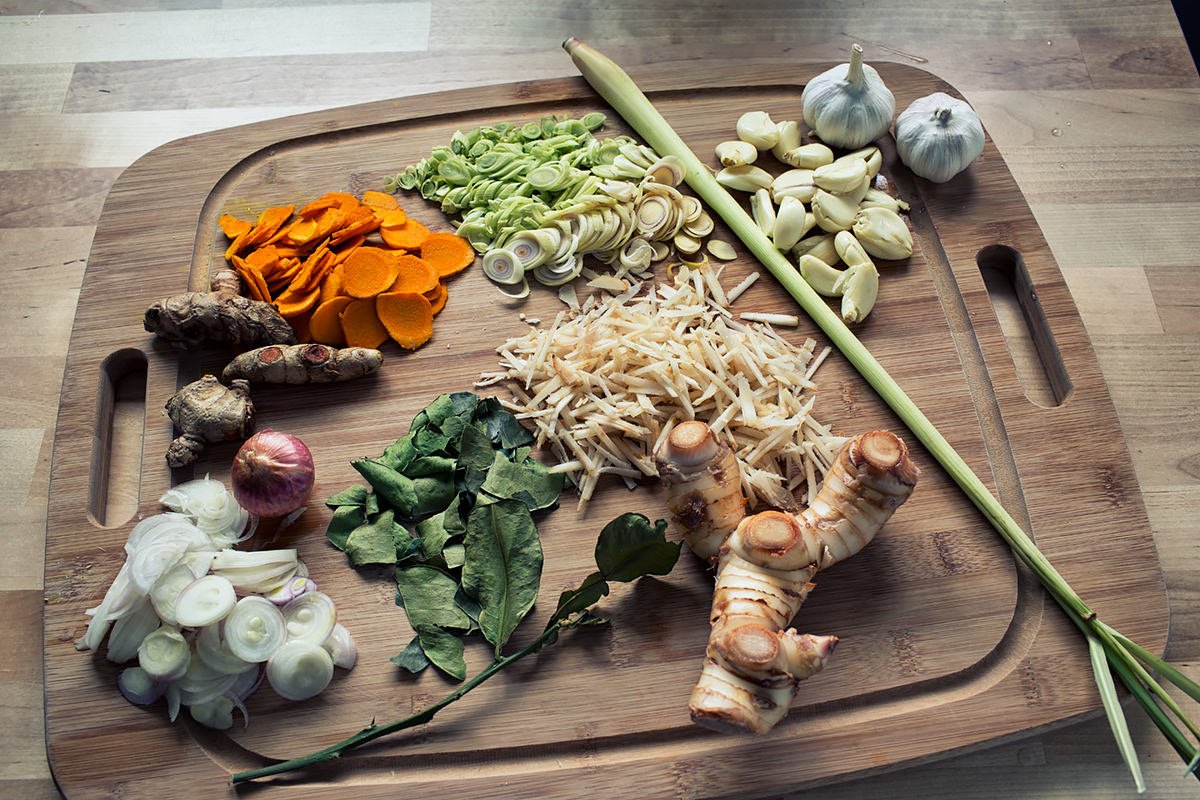
This is a basic recipe for yellow kroeung, but there are many Cambodian lemongrass paste variations available, such as the red and green version typically used to make different types of curry. This special mixture of ‘Ingredients‘ is used as a foundation for many Cambodian cuisines. Depending on the dish we’re making, the ingredients used to make kreoung will vary and change in quantities, but the base ingredients will always be galangal, turmeric, lemongrass, kaffir lime leaves, garlic, and shallots. For example, when making num banh chok, we also use the base ingredients for kroeung, but what changes the flavour, giving num banh chok somlar praheur its own unique flavours is the added ingredient such as finger roots and a little more lemongrass. For more information about kroeung and Cambodian food culture, take a look at this book.
Kroeung: Cambodian Lemongrass Paste using Fresh Ingredients
In Cambodian cuisine, we prefer to use all fresh ingredients. So every morning fresh kroeung are made, all ingredients sliced and ground to a thick paste in a mortar and pestle. Since we like to cook and eat fresh (no refrigerator in the countryside to keep ingredients for days), batches of kroeung made each morning are usually used up by the end of the day as it tends to dry out, diminishing the flavours. When I lived with my mother, this was her usual morning routine. Whenever I hear the pounding of the mortar and pestle, tuk tuk tuk, I would wake up and go watch her before getting ready for school. To this day when making kroeung or any type of lemongrass paste, the pounding sound of the mortar and pestle evoke a sense of comfort and nostalgia. But due to convenience, I usually do not make this every day. More like a large amount once a month, portioned into separate bags for whenever the Cambodian food cravings hit me.
The holy grail of Cambodian cooking, every family probably have a recipe that has been passed on from generation to generation. My grandma passed this lemongrass paste recipe to my mum and my mum knocked this recipe into my head, literally. I had the attention span of a goldfish with ADHD. Yeah, I didn’t really like cooking when I was young. What’s the point when the food is made for you? I was spoiled that way, I only started cooking when I moved out on my own. And let me tell you, once you start cooking, you start reading food books, and eventually, you start wanting to make every food from every culture. Although I do love Korean, Italian and Japanese foods, I always come back to Cambodian cooking. There’s nothing like the cooking that you grew up with, the taste of nostalgia.
How to Make Lemongrass Paste Used in Cambodian Recipes

A lemongrass paste used in many Cambodia food or Khmer food recipes such as Cambodian Curry, Stuffed Chicken Wings or Num Banh Chok.
- 6 stalks lemongrass thinly sliced
- 16 cloves garlic crushed and finely chopped
- 3 oz galangal thinly sliced
- 2 oz fresh turmeric thinly sliced
- 8 pieces kaffir lime leaves finely sliced with the hard ribs removed
- 4 pieces bird eye chilli
- 4 shallots finely chopped
- 1 teaspoon salt
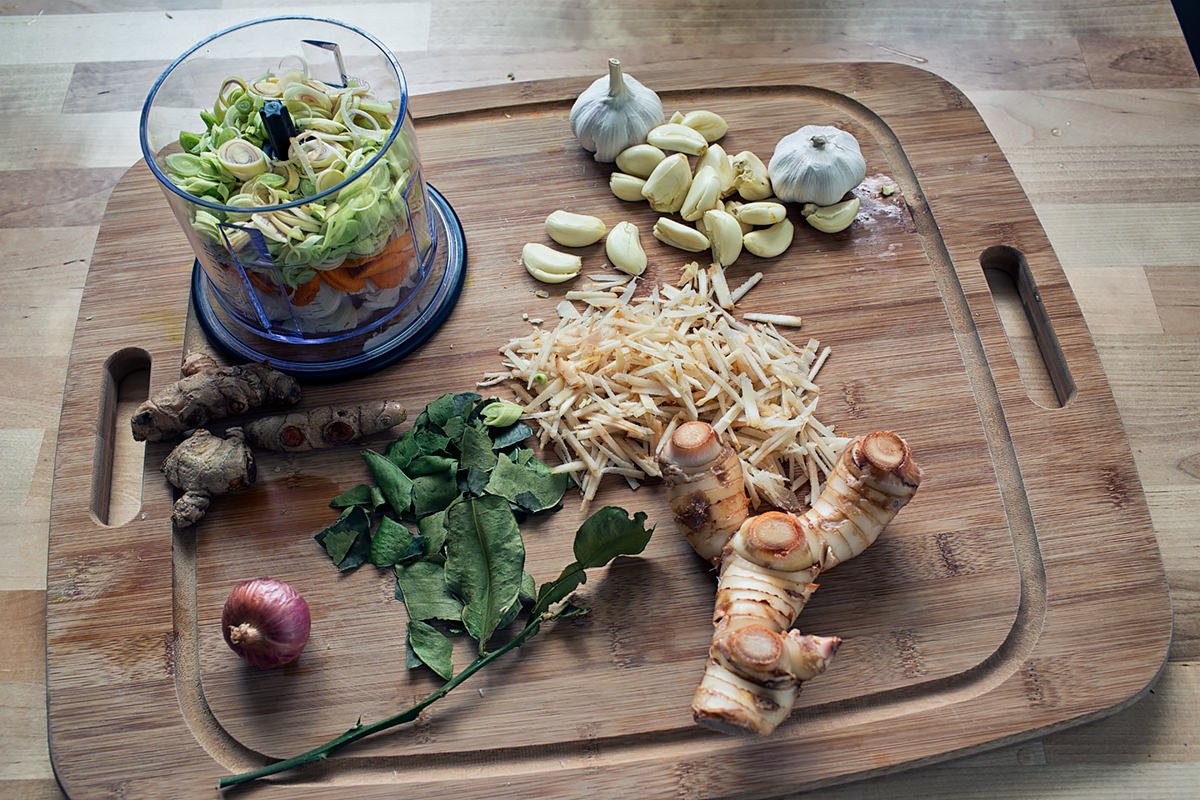
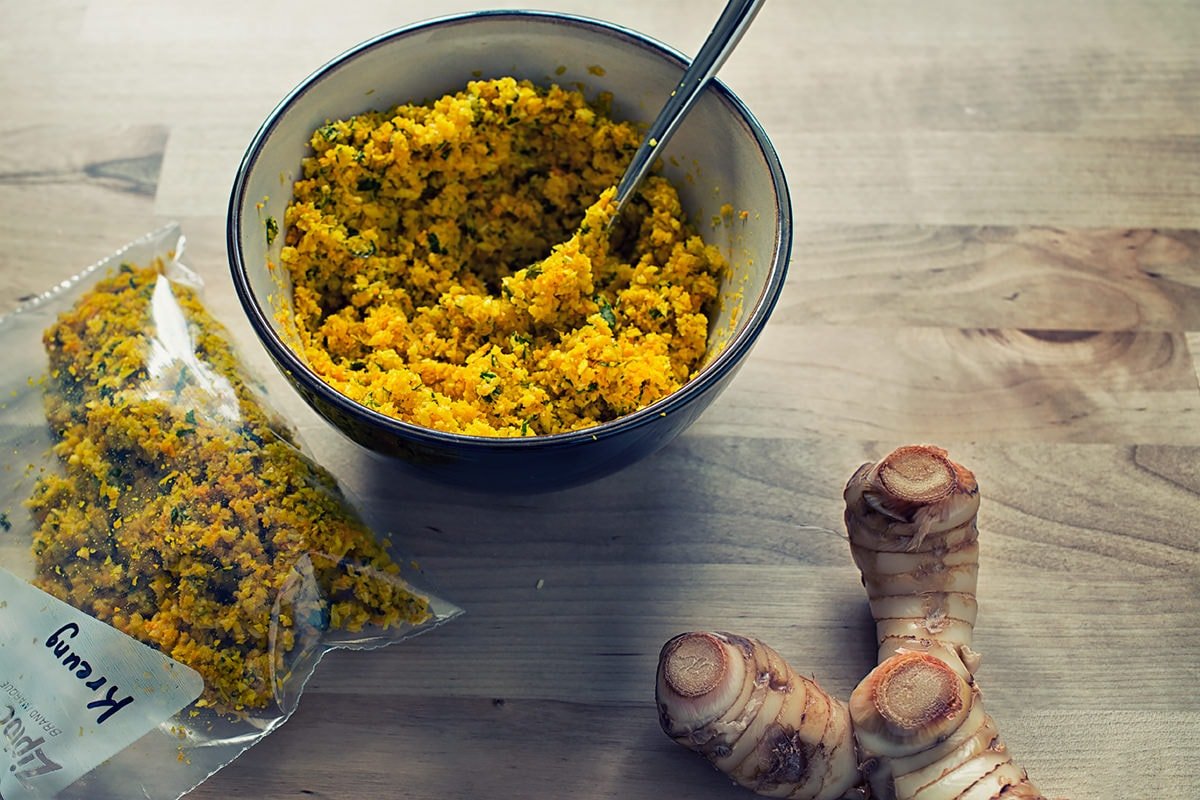
- Combine all ingredients and grind it to a paste with a blender (put the softer/easier to grind ingredients in first since the liquid that forms will help to process the other harder ingredients). After everything is ground to a paste, I like to use my mortar and pestle to grind it some more to release all of its distinctive flavours and juices.
I used 6 stalks of lemongrass, but they do vary in size, so I will give you a hint on the amount you really require. If you use for example 1 cup of galangal, you should also use the same amount of lemongrass, 1 cup.
This recipe is enough for many Cambodian stews, stir fries and soup. I like to make large batches and storing them since fresh turmeric roots leave yellow stains behind. Plus we use so much kroeung in our cooking that it makes sense to do so. I seriously hate handling turmeric, it stains everything it touches, including your skin and nails. I learn that it's always a good idea to wear those disposable plastic food handling gloves when making this. Anyways, the kroeung that I'm going to be using for two weeks will be stored in a plastic bag, while the rest of the kroeung would be placed into a glass container and freezed, which should last for months.
When you hand rip the kaffir lime leaves instead of chopping it with a knife, it releases more of their fragrance so you can really scent it in the somlar (stew).
Try these other Cambodian Food recipes that use Lemongrass Paste:
Salaw Machu Kreoung (Cambodian Beef Sour Soup)
Salaw Kari (Cambodian Curry)
Num Banh Chok (Cambodian noodle served with fish curry and freshly foraged vegetables)
Slab Moan Baok (Cambodian Stuffed Chicken Wings)


Excellent job here.You know what?I really like your writing style.I’m also a blogger and its so hard sometimes.My time will come but I know I’m on the right path.PS.I’m gonna have to share this post!
I will have to try this!
Looks easy! Can't wait to try it! Thank you!
I have never cooked with lemongrass. I know a few people that do and love it, our daughter being one. I keep saying I will try it someday, maybe I will.
Gosh there are a lot of ingredients in it, but it sounds amazing. I need to get up the courage to cook more dishes from other cuisines.
It does seem like a lot but once you gather them, it's so simple. Just chop them up and pound them into a paste. You definitely should try cuisine from every culture that you encounter. I find that it opens up your palate to new tastes, and you never know, you might just love that taste so much you'll regret the years you've wasted not eating it (it has happened to me too many times).